

Article: The Foundation of the Trouser
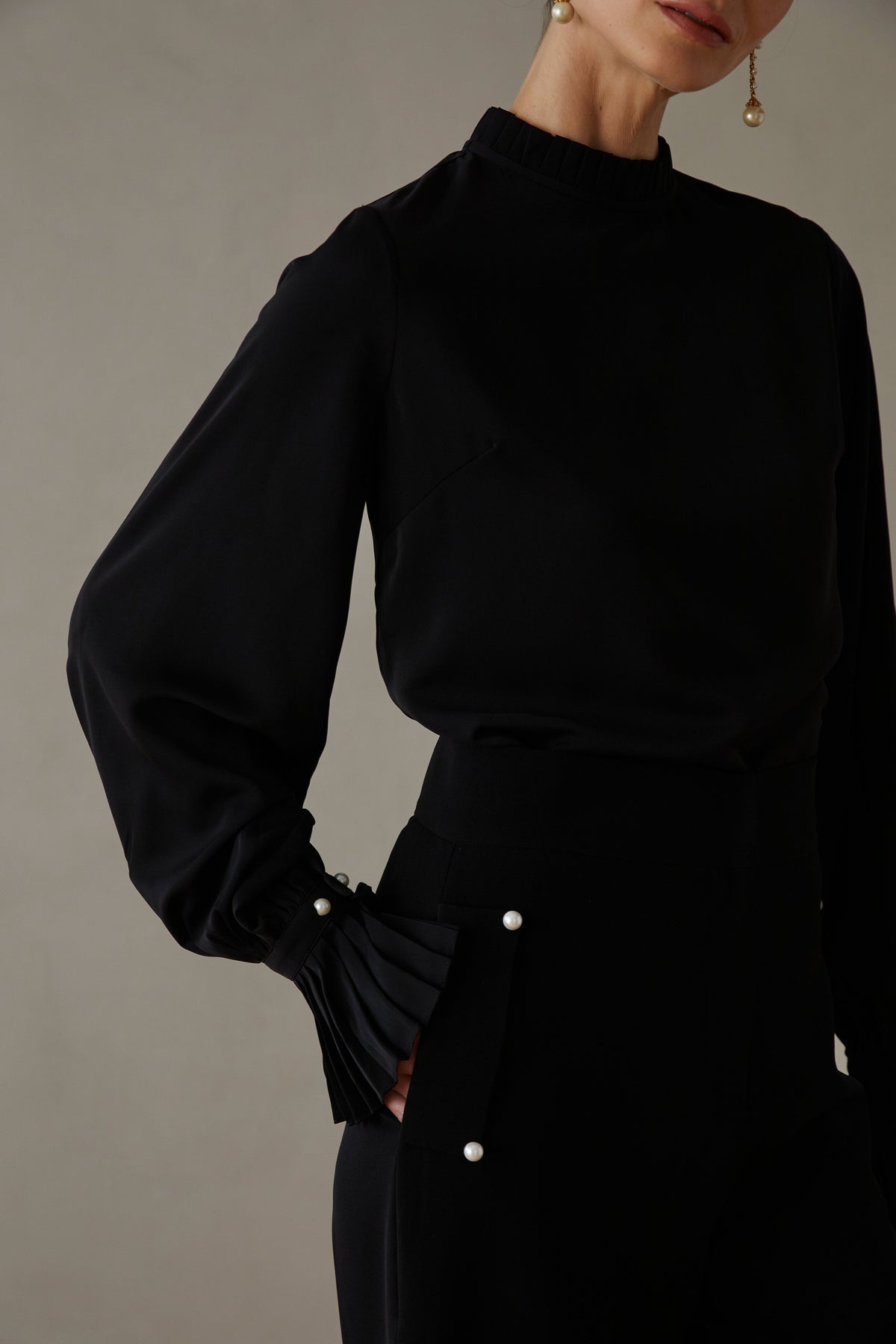
The Foundation of the Trouser
Where It Began
My relationship with trousers began long before I established VEENA CHAUHAN.
At five feet four inches tall, I never possessed the proportions traditionally associated with a runway model. I have always gravitated toward trousers rather than dresses or skirts, largely because I felt more comfortable and confident in them.
Whenever I walked into a clothing store, trousers were invariably the first pieces that caught my attention. I was drawn not simply to their silhouette, but to their details: the construction of the waistband, the placement of the pockets, the cut of the leg and the manner in which the fabric fell.
Yet finding a trouser that possessed both distinctive design and exceptional fit was remarkably difficult.
The rise was often incorrect. The waist did not sit where it should. The relationship between the hip, thigh and knee lacked balance. A trouser might appear beautiful on a hanger, yet fail to complement the proportions of the woman wearing it.
I began to understand that designing a truly exceptional trouser was far more complex than choosing between a high, mid or low waist.
Women do not share identical proportions. The length of the torso, the shape of the waist, the rise and the curvature of the hip differ from one woman to another.
I wanted to create trousers that acknowledged those differences rather than demanded that women conform to an idealized figure.
The Beginning of a Design Philosophy
In 2011, I began teaching myself to sketch, translating the ideas I envisioned into designs.
My interest in fashion was never limited to trousers. I wanted to create beautiful clothing across categories: evening gowns, cocktail dresses, tailored jackets, skirts, blouses and elegant trousers.
Although my personal wardrobe favored trousers, my creative ambition was always to design pieces that would enhance the individuality and beauty of women.
For me, design began with an observation: a garment should complement the person wearing it, not compete with her.
P20: The Original Trouser, 2012
In 2012, I designed my first trouser, P20, in tweed.
I was fortunate to work with Janet Kogan, an exceptionally skilled veteran pattern maker who understood my technical specifications and design intentions. Janet would go on to develop the technical packs for my SS14 collection, and our professional relationship became an enduring friendship.
With P20, I wanted to reconsider the construction of the waist and the relationship between fit and comfort.
Rather than following conventional distinctions of high-waisted, mid-waisted or low-waisted trousers, I developed a mid-waist design with a subtle, semi-V-shaped construction.
The waist rose higher at the back, allowing additional room through the seat when sitting. At the front, the waist dipped into a gentle V, reducing unnecessary bulk, providing greater comfort and preserving a clean, flattering line.
It was a detail born of both practicality and design.
The proportions through the hip, thigh and knee were carefully balanced, allowing the silhouette to follow the body before opening into a graceful flare toward the hem.
A side inverted pleat, finished with three pearl-loop closures, introduced a distinctive architectural element.
The result was a trouser that combined fit, comfort and individuality without sacrificing elegance.
P20 fitted beautifully.
More importantly, women responded to it. Over the years, I continued receiving requests to recreate the original design.
That response affirmed something I had always believed: women were not simply searching for another pair of trousers. They were searching for trousers that fitted them properly while offering something individual and beautiful.
Designed in 2012 and photographed in 2014, P20 remains an important part of the VEENA CHAUHAN archive.


Four Principles: Style, Design, Rise and Fit
The experience of developing P20 established four principles that continue to guide my approach to trouser design.
Style. Design. Rise. Fit.
Each is essential, but none can exist successfully without the others.
Style gives a trouser its character. Design determines its individuality. Rise establishes the relationship between the garment and the body. Fit brings every element together.
Of these, rise is among the most challenging considerations.
No two women share precisely the same waist, torso, hip or seat proportions. Even a seemingly minor adjustment can fundamentally alter how a trouser sits, moves and feels.
The challenge lies in creating a silhouette that is beautiful without being restrictive, structured without being rigid, and distinctive without compromising comfort.
I have always believed that exceptional design requires more than an attractive silhouette. It demands an understanding of construction, proportion and the woman who will ultimately wear the garment.
The Evolution: Mara and Simone
The original P20 became the foundation of my approach to trousers, eventually influencing the development of Mara and Simone.
While each design possesses its own character and construction, both reflect the principles that began with P20.
Mara is distinguished by its elevated waist, single side inverted pleat and carefully considered pocket detailing.
Simone explores a different expression of proportion through its high waist, side inverted pleats and tailored silhouette.
Neither was intended as a reproduction of P20. Rather, they represent the continued exploration of the relationship between architectural design, proportion and fit.
The silhouettes have evolved, but the philosophy remains unchanged.
Beyond the Garment
One observation has remained consistent throughout my years in fashion.
Women frequently tell me that finding beautifully designed trousers that fit correctly is extraordinarily difficult.
Their concerns are seldom about trends alone. They speak about the rise, the waist, the hip, the way a trouser sits when they move, and the absence of distinctive details in otherwise conventional designs.
These conversations reinforce my belief that the purpose of design extends beyond creating clothing.
Art requires thought, patience, experimentation and vision. Fashion, at its finest, should possess those same qualities.
I do not approach a garment merely as something to be manufactured or worn. I approach it as a composition of form, proportion and detail, created with the woman in mind.
My intention has never been to transform a woman into someone else, nor to ask her to conform to a prescribed ideal of beauty.
It is to create something that complements who she already is.
The garment should elevate the beauty of the woman, never overshadow her.
VEENA CHAUHAN

