Article: An Archive of Ideas

An Archive of Ideas
Over 2,500 Sketches: The Evolution of a Design Vision
My journey into fashion design began with an evening gown and a cocktail dress.
In 2011, I began teaching myself to sketch. I had not studied fashion illustration formally, but I had a vision of the silhouettes I wanted to create and a desire to translate those ideas onto paper.
I was drawn to elegance, proportion, intricate construction and the details that give a garment its individuality.
Over the years, that exploration has grown into an archive of more than 2,500 sketches encompassing evening gowns, cocktail dresses, tailored jackets, trousers, day dresses, skirts and blouses.
Many of these designs explore the complexity of construction and detail associated with couture-level work.
Each sketch represents an idea, an experiment in proportion or an exploration of form. Some have been brought to life. Others remain in the archive, waiting for the right moment to evolve.
Where It Began: An Evening Gown Inspired by Nature
One of my earliest evening gown designs began with an image of calla lilies.
The deep burgundy-purple flowers, with their elongated stems and gracefully unfolding petals, were accompanied by diamond rings. I was captivated by the composition: the contrast between the organic beauty of the flowers and the refinement of the jewelry.

What interested me was the relationship between structure and movement.
The calla lilies possessed an extraordinary natural architecture. Their petals curved, overlapped and opened with an elegance that appeared effortless.
I wanted to explore how those qualities could be interpreted through clothing.
In January 2013, I created sketch #130, an evening gown with a sculpted halter neckline, a fitted bodice, a defined waist and a voluminous, sweeping skirt.


The design explored the contrast between a controlled upper silhouette and the fluid movement of fabric below the waist.
It was an early expression of something that continues to fascinate me today: the ability to create architectural form while preserving softness, femininity and movement.
The inspiration did not come from an existing garment or a seasonal fashion trend. It came from observing beauty in another form and imagining how that beauty might translate into clothing.
The Cocktail Dress: Exploring Architectural Form
Alongside my early eveningwear designs, I began exploring cocktail dresses.
The cocktail dress offered a different canvas for creativity. Unlike the sweeping volume of an evening gown, its shorter silhouette allowed me to concentrate on the relationship between the neckline, bodice, waist and skirt.
One of my early designs, created in a striking shade of blue, explored this relationship through a dramatic standing collar, a sculptural bow at the neckline and a softly gathered skirt.

The collar framed the face, while the bow introduced dimension and movement. The contrast between the structured neckline and the fluid skirt became an essential part of the composition.
I was interested in creating pieces that had character: garments that could be recognized through their silhouette and details rather than through a visible logo.
Looking at those early designs today, I can recognize elements of the design language that would continue to develop within the House: architectural collars, sculptural forms, expressive details and an emphasis on proportion.
More Than 2,500 Sketches: An Evolving Archive
Over the years, I have created more than 2,500 sketches.
They encompass evening gowns, cocktail dresses, jackets, trousers, day dresses, skirts and blouses. Many explore elaborate silhouettes, unconventional details and complex construction.


For me, these sketches represent far more than a collection of drawings.
They are an archive of creative ideas accumulated through years of observation, experimentation and refinement.
Some designs begin with the smallest detail: the curve of a collar, an unusual cuff, the placement of a pleat or the movement of fabric.
Others begin with an entire silhouette.
A sketch may capture the initial vision, but translating that vision into a finished garment is an entirely different discipline.
The fabric must support the design. The pattern must translate the intended proportions. The construction must preserve the shape, and the fit must complement the body.
Sometimes the original sketch requires very little alteration. At other times, the design must be reconsidered repeatedly before the final silhouette is achieved.
Not every sketch becomes a garment, nor do I believe that every idea should immediately be brought into production.
Some remain part of the archive. Others evolve into new interpretations years later.
An idea does not lose its value simply because time has passed.
From Eveningwear to Tailoring
Although my first designs were an evening gown and a cocktail dress, my creative interests have never been confined to one category of clothing.
I have always wanted to create beautiful garments for women, whether an evening gown, a tailored jacket, an elegant trouser, a distinctive blouse or a day dress.
The common thread is my interest in proportion, construction and individuality.
That philosophy eventually extended to my approach to trouser design.
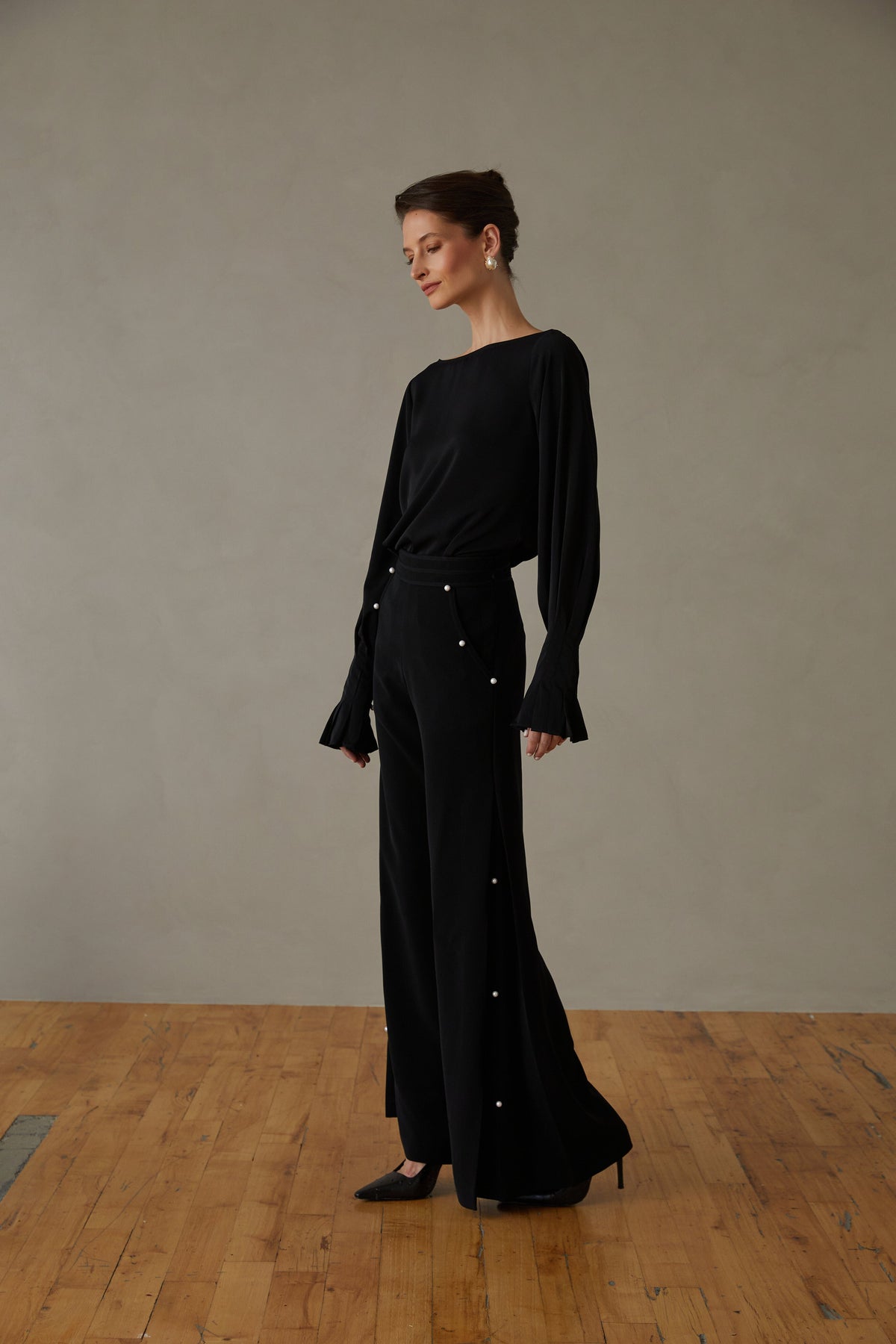
In 2012, I created P20, my original tweed trouser. Its distinctive waist construction, carefully considered rise and architectural detailing established the foundation of my approach to tailoring.
Years later, those principles would continue through Mara, the direct evolution of P20.
The same pursuit of balance and proportion that informed my early eveningwear designs continues to influence the development of trousers, jackets, collars and cuffs.
My design language has evolved, but the fundamental intention remains unchanged.
The Time Behind a Design
Creating an original design requires patience.
A drawing may take shape quickly, but developing it into a garment can take months or even years.
Mara required two years of development before I was satisfied with its final fit. The relationship between the waist, rise and hip demanded repeated refinement, including fittings on real women with different body proportions.
The Shakespeare-inspired collar of Rani presented a different challenge: achieving the intended shape, scale and architectural presence.
The origami-inspired cuffs and Rani's rounded, flared overlapping cuff required their own exploration of form and construction.
These details may appear effortless in the finished garment, but reaching that point requires observation, technical development and an unwillingness to compromise the original vision.
For me, every element must have a reason for existing.
A collar must complement the face and shoulders. A cuff must balance the sleeve. A trouser must sit correctly on the body, and a dress must maintain its intended proportions while allowing movement.
The smallest detail can determine the success of an entire design.
Creativity Beyond the Fashion Calendar
As the sole founder of VEENA CHAUHAN, my responsibilities extend beyond sketching and designing.
I am involved in fabric sourcing, product development, fittings, production and the many operational responsibilities of building an independent luxury fashion house.
Balancing the creative process with these responsibilities requires considerable time and discipline.
But I do not believe that design should be rushed simply to meet the demands of a conventional fashion calendar.
I do not create garments merely because a new season has arrived.
I create because I have an idea worth exploring.
Sometimes that idea develops quickly. Sometimes it requires years of refinement.
What matters to me is that the final garment reflects the vision behind it.
My archive continues to grow, and many designs have yet to be realized. I see them not as unfinished work, but as creative possibilities that may find their place in future collections.
The Continuing Vision of VEENA CHAUHAN
Looking back at my early evening gown and cocktail dress, I see the beginning of a design philosophy that continues to define my work.
The inspiration may come from nature, architecture, an object, a particular fabric or simply an idea that takes shape in my imagination.
But the intention remains consistent.
I want to create garments that possess individuality, elegance and a sense of purpose.
I believe fashion is a form of artistic expression, one that requires not only creativity but also an understanding of construction, proportion and the woman who will ultimately wear the design.
The archive of more than 2,500 sketches represents the evolution of that belief.
Some ideas have become garments. Others remain on paper. All are part of a continuing exploration of design.
I do not believe a garment should exist merely to follow a trend or fulfill a season. It should exist because it has something distinctive to offer.
Above all, I believe the garment should elevate the beauty of the woman wearing it, never overshadow her.
VEENA CHAUHAN